
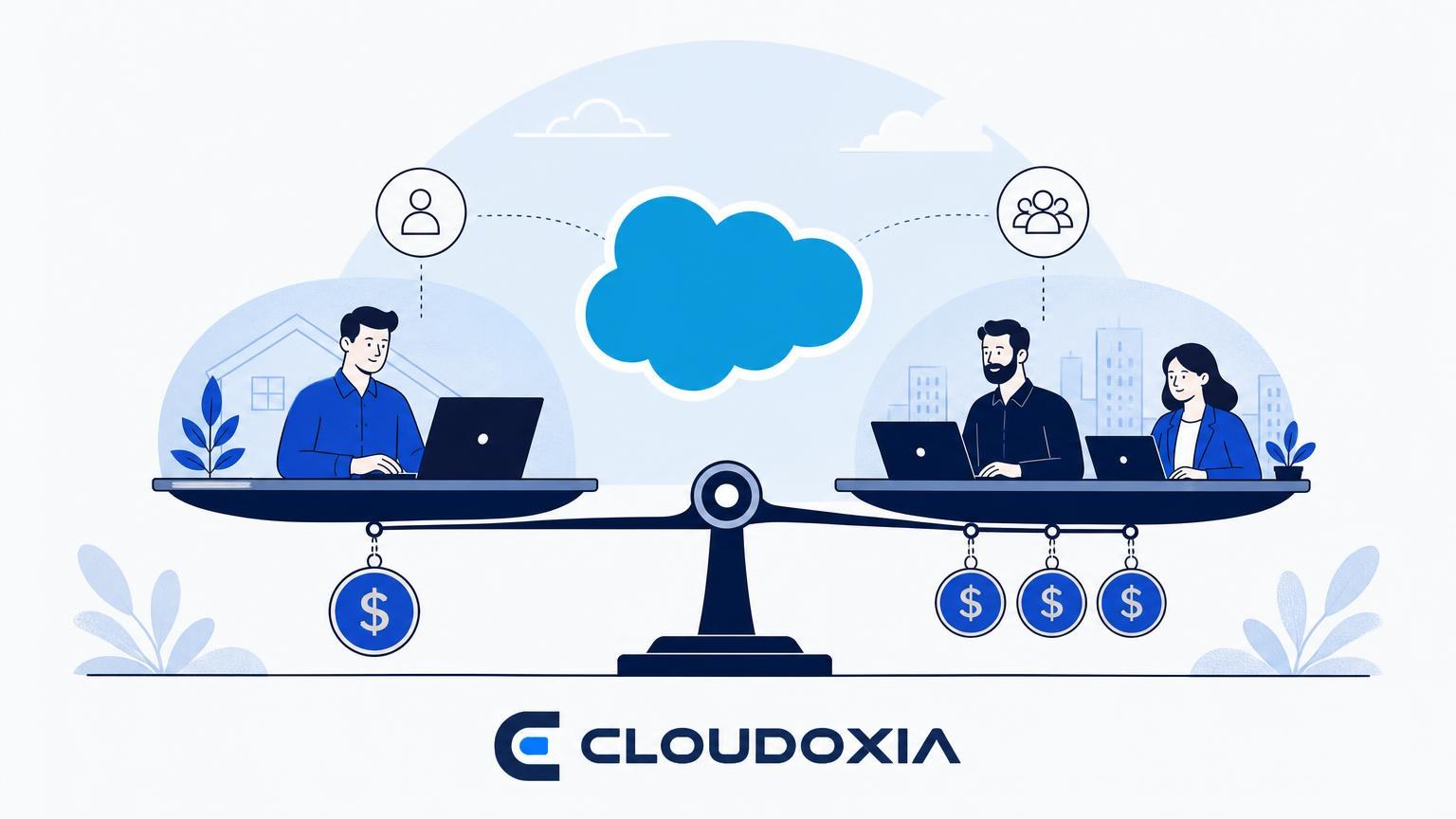
Every growing company hits the same fork in the road with Salesforce: do you hire a dedicated admin to manage the platform, or do you contract with a managed services provider? The answer isn’t as simple as comparing a salary to a monthly retainer. There are layers of cost, risk, and strategic trade-offs that most comparison articles gloss over entirely. Having watched organizations of all sizes wrestle with this decision, I can tell you the “right” choice depends on factors that rarely show up in a basic spreadsheet. Your company’s maturity, the complexity of your Salesforce org, your growth trajectory, and even your tolerance for operational risk all play a role. This piece breaks down the real costs on both sides, including the ones that don’t appear on a P&L statement, so you can make a decision grounded in specifics rather than gut feeling. Whether you’re a 50-person SME or a multi-division enterprise rolling out Agentforce Sales Agents, the financial and strategic implications of choosing between a Salesforce admin and managed services deserve a clear-eyed comparison.
Direct Cost Analysis of a Full-Time In-House Salesforce Admin
Hiring an in-house admin seems straightforward until you actually tally up every line item. The sticker price on a job posting rarely reflects the true cost of keeping a qualified person in that seat year after year.
Base Salary, Benefits, and Payroll Tax Burdens
In 2026, the average base salary for a certified Salesforce Administrator in the United States sits between $95,000 and $125,000, depending on metro area and experience level. Senior admins with specialized skills in CPQ, Marketing Cloud, or Flow automation can command $130,000 to $150,000. But salary is only part of the picture.
Employer-paid benefits typically add 25% to 35% on top of base compensation. That includes health insurance, 401(k) matching, paid time off, and employer-side payroll taxes (FICA, FUTA, state unemployment). For a $110,000 admin, you’re realistically looking at $137,500 to $148,500 in total compensation. Many companies forget to factor in the cost of tools and software licenses the admin will need: sandbox environments, DevOps tools, data backup solutions, and project management platforms can easily add another $5,000 to $10,000 annually.
Recruitment Fees and Onboarding Overhead
Finding the right Salesforce admin takes time. The average time-to-fill for a specialized Salesforce role runs 45 to 75 days. If you use a staffing agency, expect to pay 15% to 25% of the first-year salary as a placement fee, which means $16,500 to $27,500 for that $110,000 hire.
Onboarding carries its own costs. A new admin needs weeks to learn your org’s architecture, understand your business processes, and get up to speed on existing automations and integrations. During this ramp-up period (typically 30 to 90 days), productivity is limited. If the hire doesn’t work out, and turnover in the Salesforce ecosystem remains stubbornly high, you start the cycle all over again.
Continuous Learning and Certification Maintenance Costs
Salesforce releases three major platform updates per year, and the pace of new features has accelerated with AI-driven capabilities like Agentforce. Keeping an admin’s skills current isn’t optional: it’s a business necessity. Certification exam fees run $200 to $400 each, and most admins hold two to five certifications. Training courses, whether through Trailhead Academy or third-party providers, can cost $2,000 to $5,000 per course.
Budget $3,000 to $8,000 annually for professional development, plus the opportunity cost of the admin being away from their daily work during training. This is money well spent if you retain the person, but it’s a sunk cost if they leave within 18 months.
The Managed Services Pricing Model: Predictability vs. Flexibility
Managed services providers structure their pricing differently than a salaried hire, and the model you choose has real implications for budgeting and resource allocation.
Subscription-Based Support vs. Project-Based T&M
Most managed services engagements fall into one of two buckets. Subscription-based plans offer a fixed monthly retainer, typically ranging from $3,000 to $15,000 per month depending on the hours included and the complexity of support needed. You get a predictable line item in your budget, and unused hours may roll over depending on the contract.
Time-and-materials (T&M) arrangements, on the other hand, charge for actual hours consumed. Hourly rates for Salesforce managed services generally fall between $150 and $250 per hour. T&M works well for organizations with unpredictable or seasonal Salesforce needs, but it introduces budget variability. The subscription model tends to win for companies that need consistent, ongoing support, while T&M suits those with periodic project-based requirements.
A provider like Cloudoxia structures its managed services with a predictable monthly model and a structured five-phase methodology, which removes the guesswork from budgeting and delivery timelines. That kind of predictability matters when you’re reporting costs to a CFO who hates surprises.
Fractional Salesforce Support Benefits for SMEs
Small and mid-sized businesses often can’t justify a full-time admin’s salary. A company with 30 Salesforce users doesn’t need 40 hours a week of admin time: they might need 15 to 20 hours. Fractional Salesforce support lets SMEs access certified expertise at a fraction of the full-time cost.
The math is compelling. A $5,000 monthly retainer for 20 hours of managed support costs $60,000 per year, compared to $140,000 or more for a full-time hire with benefits. You’re also getting access to a team rather than a single person, which means broader skill coverage and no gaps during vacations or sick days. For SMEs, the fractional support model often delivers better value per dollar than any other option.
Evaluating Skill Breadth and Technical Debt Risks
Cost is only one dimension. The expertise gap between a solo admin and a managed services team can create risks that compound over time.
The Cost of the ‘Single Point of Failure’ in In-House Roles
Here’s a scenario I’ve seen play out repeatedly: a company hires a talented admin who builds complex automations, custom objects, and integrations over two or three years. That admin leaves. Nobody else understands the architecture. The org becomes fragile, and every change carries risk because there’s no documentation and no institutional knowledge.
This “single point of failure” problem isn’t hypothetical: it’s one of the most common and expensive risks in Salesforce operations. The cost of untangling poorly documented or overly complex configurations can run $20,000 to $50,000 or more in consultant fees. Even if your admin doesn’t leave, a single person can’t be an expert in everything. They might be strong in Sales Cloud but weak in integration architecture, or great at reports but unfamiliar with Apex development. Those gaps create technical debt that accumulates quietly until something breaks.
Accessing Multi-Disciplinary Expertise via Managed Services
A managed services provider staffs a bench of specialists: admins, developers, architects, and consultants who collectively cover the full Salesforce ecosystem. When your org needs a complex API integration, you get a developer. When you need a data migration strategy, you get an architect. You’re not asking one person to be everything.
This team-based approach also provides built-in quality assurance. At Cloudoxia, for example, certified architects review and sign off on every design and deliverable, which creates an accountability layer that a solo admin simply can’t replicate. The breadth of expertise reduces technical debt, improves solution quality, and ensures that your Salesforce org evolves in a sustainable way rather than becoming a tangle of workarounds.
Strategic ROI for Enterprise-Scale Organizations
Enterprise organizations face a different set of calculations. The question isn’t just cost: it’s whether your Salesforce support model can keep pace with strategic initiatives.
Salesforce Managed Services ROI for Enterprise Organizations
Large enterprises typically run multi-cloud Salesforce environments: Sales Cloud, Service Cloud, Marketing Cloud, Experience Cloud, and increasingly Data Cloud. Managing this ecosystem requires diverse expertise that’s expensive to assemble in-house. An enterprise might need two to four full-time Salesforce staff, costing $400,000 to $700,000 annually in total compensation, and still face skill gaps.
A managed services engagement for an enterprise might run $15,000 to $30,000 per month, or $180,000 to $360,000 annually. The ROI shows up in several places: faster resolution times (Cloudoxia’s median first response time is under four hours with 24/7 coverage), reduced downtime, and the ability to execute strategic projects without hiring additional headcount. Enterprise organizations that track their Salesforce managed services ROI consistently find that the cost savings are secondary to the speed and quality gains.
Scaling Support for Agentforce Sales Agents and AI Implementation
The rollout of Agentforce Sales Agents has added a new layer of complexity to Salesforce operations. Configuring, training, and maintaining AI agents requires skills that most in-house admins haven’t developed yet: prompt engineering, agent orchestration, data grounding, and guardrail configuration.
Managed services providers that stay current with Salesforce’s AI capabilities can deploy and manage Agentforce implementations without the learning curve and trial-and-error that an in-house team would face. For enterprises planning AI-driven sales automation, this expertise gap alone can justify the managed services investment. The alternative: sending your admin through months of training while your competitors are already running autonomous agents, is a competitive risk, not just a cost consideration.
Hidden Opportunity Costs and Resource Utilization
The costs that don’t show up on invoices are often the ones that matter most. Opportunity costs are real, even if they’re harder to quantify.
Downtime and Backlog Management Expenses
Every Salesforce admin accumulates a backlog. User requests, bug fixes, enhancement ideas, and compliance updates pile up. A single admin managing a growing org will inevitably face a backlog that stretches weeks or months. The business impact of delayed requests: a sales team waiting for a new lead scoring model, a service team needing updated case routing: is hard to measure but very real.
Downtime is even more expensive. If a critical automation breaks during a platform release and your admin is on vacation or overwhelmed with other tasks, the business impact can be significant. Lost productivity across a 200-person sales team for even half a day can cost tens of thousands of dollars in delayed pipeline movement. Managed services teams, with their bench depth and SLA commitments, dramatically reduce this risk.
Speed to Market for New Feature Releases
Salesforce’s three annual releases bring new features that can create competitive advantages, but only if you implement them quickly. An in-house admin juggling daily operations, user support, and strategic projects will naturally deprioritize new feature adoption.
A managed services team can evaluate new releases proactively, recommend relevant features, and implement them within days or weeks of availability. This speed-to-market advantage compounds over time. Organizations that consistently adopt relevant new features: Einstein AI capabilities, Flow orchestration improvements, enhanced analytics: outperform those that lag behind by a release cycle or two.
One client review of Cloudoxia’s services captures this well: “Very responsive, technically capable, and flexible with project needed adjustments. In the end they put quality first with wonderful customer service and I am thankful to have found them to help us along our CRM implementation journey.” That responsiveness and flexibility is exactly what keeps feature adoption on track.
Final Verdict: Matching Support Models to Business Maturity
The choice between hiring a Salesforce admin and engaging managed services isn’t binary, and the right answer shifts as your company grows.
For SMEs with fewer than 100 Salesforce users and relatively standard configurations, fractional managed services almost always deliver better economics and broader expertise than a full-time hire. You get team-based coverage, predictable costs, and access to specialists you’d never be able to hire individually.
For mid-market companies with 100 to 500 users, a hybrid model often works best: one in-house admin who handles day-to-day user support and knows the business deeply, supplemented by a managed services partner for development, integrations, and strategic projects.
For enterprises running complex, multi-cloud environments and deploying AI capabilities like Agentforce, managed services provide the scale, specialization, and speed that a small internal team can’t match. The ROI case is strongest here, where the cost of falling behind on platform capabilities directly affects revenue.
Whichever model you choose, the worst decision is the one made purely on sticker price. Factor in recruitment risk, technical debt, opportunity costs, and the pace of Salesforce innovation. The platform is evolving faster than any single person can keep up with, and your support model needs to reflect that reality.
If you’re weighing these options and want a partner who can scale with you, Cloudoxia’s managed services team offers the kind of predictable, architect-led support that eliminates the guesswork. Maximize Your Salesforce ROI by pairing your team with certified experts who respond in hours, not days, and hand you full ownership of every deliverable.