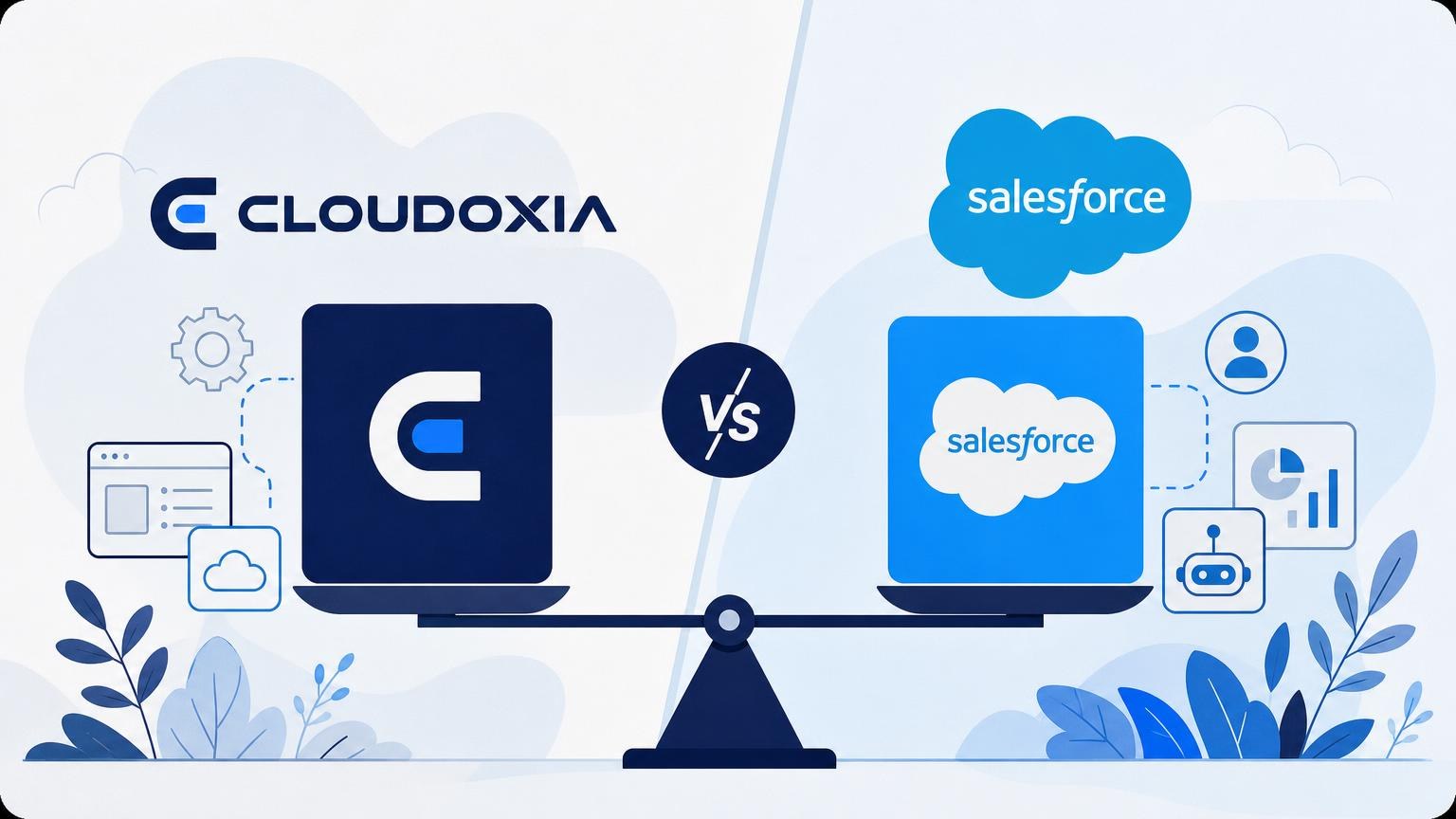
Most people asking about the difference between Claudeforce and Agentforce are starting from a reasonable but incorrect assumption: that these are two competing products and you need to pick one. They’re not, and you don’t. One is a platform. The other is a partnership that changed what powers that platform. Getting this distinction right saves you from making a costly architectural mistake, so here’s the full picture.
Quick Verdict: Understanding the Engine vs. the Car
If you only have 60 seconds, here’s what matters. Agentforce is Salesforce’s platform for building and deploying autonomous AI agents. It includes the tools, governance, and infrastructure you build on top of. Claudeforce is the name for the expanded Salesforce-Anthropic partnership, announced August 26, 2026, that made Anthropic’s Claude a default reasoning model inside Agentforce, brought Salesforce data into the Claude app, and made Claude the default model in Slack.
Claude doesn’t replace Agentforce. It runs inside it. Asking “Claudeforce vs Agentforce: what is the difference?” is like asking what’s the difference between an engine and the car it sits in. The engine is critical, but you still need the chassis, the brakes, and the steering wheel.
The real question isn’t which one to choose. It’s which surface fits your use case: an autonomous agent handling customer interactions (Agentforce), a seller working from inside Claude’s app (Salesforce in Claude), or a custom integration wired through the API and Model Context Protocol (a bespoke build). Many organizations will use two or all three.
| Agentforce | Claudeforce (Partnership) | |
|---|---|---|
| What it is | Salesforce’s AI agent platform | Salesforce-Anthropic strategic partnership |
| Category | Product / Platform | Integration layer / Partnership |
| Announced | 2024 (evolved from Einstein Bots) | August 26, 2026 |
| Key components | Atlas Reasoning Engine, Agent Builder, Trust Layer, Topics & Actions | Claude in Agentforce, Salesforce in Claude app, Claude in Slack |
| Model dependency | Model-agnostic by design | Claude is the default model; others remain available |
| Primary user | Admins, developers, architects building agents | End users (sellers, service reps) and builders choosing Claude as the reasoning model |
| Governance | Built-in Trust Layer with data masking, grounding, audit trails | Inherits Agentforce’s Trust Layer; runs through Amazon Bedrock inside Salesforce’s VPC |
| Pricing | Per-conversation pricing (varies by agent type) | Included in Agentforce licensing for the in-platform model; Claude app and Slack usage may carry separate costs |
| Build required | Yes: configure Topics, Actions, and agent logic | Minimal for Claude in Slack; moderate for Salesforce in Claude; full build for Agentforce agents |
| Best for | Autonomous, governed AI agents at scale | Enhancing reasoning quality, seller productivity, cross-platform AI access |
Agentforce: The Foundation for Autonomous AI Agents
Agentforce is what replaced the older Einstein Bots, and the jump in capability is significant. Where Einstein Bots followed scripted decision trees, Agentforce agents reason, plan, and act across your CRM data with genuine autonomy, within boundaries you define.
Think of it as the full stack for deploying AI workers: the reasoning layer, the governance layer, and the builder tools. Without Agentforce, a raw language model has no idea what your business rules are, which records it can touch, or when it should escalate to a human. Agentforce provides all of that.
The Atlas Reasoning Engine and Agent Builder
The Atlas Reasoning Engine is the planning core. When an agent receives a request, Atlas breaks it into steps, decides which actions to call, evaluates results, and determines the next move. It’s not a simple prompt-response loop; it’s a multi-step reasoning chain that can pull data from multiple objects, evaluate conditions, and course-correct mid-task.
Agent Builder is where your team actually assembles agents. You define what the agent does, what data it can access, and how it should behave in specific scenarios. It’s low-code enough for experienced admins but flexible enough for developers to extend with custom Apex or Flow actions.
Governance via the Salesforce Trust Layer
This is the piece that makes Agentforce deployable in real enterprises rather than just impressive in demos. The Trust Layer handles data masking (so sensitive fields aren’t exposed to the model), grounding (so the agent’s responses are anchored in your actual data rather than hallucinated), and audit logging (so you can review every decision the agent made and why).
For regulated industries like financial services or healthcare, the Trust Layer isn’t optional. It’s the reason an AI agent can interact with customers without creating a compliance nightmare.
Defining Scope through Topics and Actions
Topics and Actions are how you constrain what an agent can do. A Topic is essentially a job description: “Handle order status inquiries” or “Qualify inbound leads.” Actions are the specific operations the agent can perform within that topic: look up an order, update a case status, send a follow-up email.
This scoping is what separates a useful agent from a dangerous one. An agent with access to everything and permission to do anything is a liability. An agent with three well-defined Topics and twelve specific Actions is a productive team member.
Claudeforce: The Anthropic and Salesforce Partnership
Claudeforce isn’t a product you install. It’s the umbrella name for everything that came out of the expanded Salesforce-Anthropic partnership. It touches three distinct surfaces, and understanding each one matters because they serve different users and use cases.
Claude as the Default Reasoning Model
This is the change that generated the most confusion. Claude is now a default option for the reasoning model inside Agentforce. When you build an agent in Agent Builder, Claude can be the intelligence doing the thinking behind Atlas. It runs through Amazon Bedrock inside Salesforce’s virtual private cloud, which means your data stays within the Salesforce trust boundary. That’s a meaningful detail for anyone in a regulated industry.
Agentforce remains model-agnostic. You’re not locked into Claude. But Anthropic’s model is now the default for features like Agentforce Vibes and Agentforce Coworker, and it’s the recommended option for new builds. Salesforce clearly sees Claude’s reasoning capabilities as a step up for complex agent tasks.
Slack Integration and the Claude App Ecosystem
The second surface is Claude as the default model in Slack. Claude can now access channels, messages, and files through Slack’s Model Context Protocol server, connecting through to Salesforce and Tableau data. For teams that live in Slack, this means AI-powered summaries, data lookups, and draft responses without switching apps.
The third surface is Salesforce inside the Claude app itself. This brings 37 prebuilt sales skills into Claude’s interface: meeting prep, deal-health reviews, pipeline analysis. A seller can ask Claude to prep them for a call, and Claude pulls live CRM data to build the briefing. No tab-switching, no manual report pulling.
Neither of these surfaces competes with Agentforce. They extend where Salesforce data shows up and how people interact with it.
Direct Comparison: Platform vs. Partnership
The distinction between Claudeforce and Agentforce becomes clearest when you look at what each one actually does in your org.
Agentforce is infrastructure. It’s the thing you build on, test against, and govern through. Without it, you don’t have Topics, Actions, trust boundaries, or agent deployment. It exists whether or not Claude is involved.
Claudeforce is an upgrade to what powers that infrastructure, plus two new access points. It made the reasoning better (Claude’s model), the seller experience faster (Salesforce in Claude), and the collaboration layer smarter (Claude in Slack). But none of those things work without the platform underneath.
Here’s a practical way to think about it: if Salesforce announced tomorrow that they were partnering with a different AI lab, say Google’s Gemini, the hypothetical “Geminiforce” would slot into the same architecture. Agentforce wouldn’t change. The model inside it would.
That’s why asking about the difference between Claudeforce and Agentforce is really asking about the difference between a component and the system it belongs to. Useful to understand, but not a choice you need to make between them.
Choosing Your Path: Implementation Strategies
The practical decision isn’t “which product do I buy.” It’s “what problem am I solving, and which surface solves it fastest.”
Building Autonomous Agents on CRM Data
If you need an AI agent that handles customer-facing interactions, like deflecting tier-one support cases, qualifying inbound leads, or answering employee policy questions, you’re building on Agentforce. The agent runs autonomously within the boundaries you set, using Claude (or another model) for reasoning.
This path requires the most setup: defining Topics and Actions, configuring the Trust Layer, testing edge cases, and establishing human escalation points. It also delivers the most value at scale. A well-built service agent can handle thousands of interactions per day with consistent quality.
One thing we’ve seen repeatedly at Cloudoxia: organizations that rush the scoping phase end up rebuilding. The difference between “an AI agent for customer service” and “an AI agent that handles order status, return eligibility, and shipping updates for logged-in customers” is the difference between a project that ships and one that stalls. Our Agentforce implementation practice starts with use-case definition for exactly this reason, because the technology works. The hard part is defining what it should do.
Custom Builds via API and Model Context Protocol
When the prebuilt surfaces don’t fit your workflow, you connect Claude to Salesforce directly through the Anthropic API and Model Context Protocol (MCP). This is the path for teams building custom internal tools, embedding AI into specific automations, or wiring Claude into workflows the packaged options don’t cover.
MCP is what makes this safe. It lets Claude reason over your org’s data with scoped access: read-first, specific objects only, with a human gate on anything that writes. Without MCP, you’d be handing Claude an API key and hoping for the best. With it, you get controlled, auditable access.
This approach requires developer resources and careful architecture, but it’s the most flexible option. If you have a unique process that doesn’t map to a standard agent template, this is how you build it.
Common Questions About the Salesforce-Anthropic Ecosystem
Is Claudeforce replacing Agentforce?
No. Claudeforce made Claude the default reasoning model inside Agentforce. Agentforce is still the platform. Claude is now the recommended engine powering it. You still need Agentforce to build, deploy, and govern agents.
Can I still use other models with Agentforce?
Yes. Agentforce is model-agnostic by design. Claude is the default for new features like Agentforce Vibes and Coworker, but the platform supports other models. The architecture separates the reasoning model from the governance and deployment layers.
What does “default model” actually mean in practice?
It means Claude is pre-selected when you create new agents or use features like Vibes and Coworker. You can change this, but Salesforce is signaling that Claude is their preferred reasoning engine going forward.
Is my data safe with Claude running inside Agentforce?
Claude runs through Amazon Bedrock inside Salesforce’s virtual private cloud. Your data stays within the Salesforce trust boundary, subject to the same Trust Layer protections: data masking, grounding, and audit logging. For regulated industries, this architecture was specifically designed to meet compliance requirements.
Do I need to buy Claudeforce separately?
Claudeforce isn’t a separate SKU. Claude as a reasoning model is part of Agentforce licensing. The Salesforce-in-Claude app and Claude-in-Slack features may have their own licensing terms. Check with Salesforce for current pricing, as this is still rolling out from the August 2026 announcement.
When can I actually use this?
As of late 2026, Claudeforce features are in select-customer pilot with an open beta that began in September 2026. Availability varies by feature: Claude in Agentforce is furthest along, while some Claude app integrations are still in early access.
Should I wait for general availability or start preparing now?
Start preparing now. The preparation work, cleaning your CRM data, defining sharing rules, scoping your first use case, and establishing governance policies, pays off regardless of timeline. Every week of clean data is a week your future agents will perform better.
Future-Proofing Your AI Strategy with Clean Data
The single highest-return thing you can do right now, before you deploy any agent on any surface, is fix your data. Every one of these AI surfaces reasons over your CRM. If your accounts have duplicate records, your contacts have stale email addresses, and your opportunity stages don’t reflect your actual sales process, no amount of AI sophistication will save you.
Here’s a practical starting checklist:
- Audit your data model. Are your custom objects and fields actually used? Dead fields confuse agents.
- Clean your records. Deduplicate accounts and contacts. Update stale records. Archive what’s obsolete.
- Review sharing rules. AI agents inherit your org’s permissions. If your sharing model is a mess, your agent’s access will be too.
- Define your first use case narrowly. “AI for sales” isn’t a use case. “Automated meeting prep for the enterprise sales team using opportunity and activity data” is.
- Set a human gate. For any agent that writes to records or sends messages to customers, require human approval until you’ve validated quality over at least 500 interactions.
One client review on AppExchange captures what this kind of disciplined approach looks like in practice: “They always take the time to understand what we’re trying to solve and achieve, propose clear solution options with tradeoffs, and then execute cleanly and efficiently.” That’s the mindset that separates successful AI deployments from expensive experiments.
The Salesforce-Anthropic partnership is a meaningful shift in how AI agents get built and where they show up. But the fundamentals haven’t changed: clean data, scoped access, clear use cases, and human oversight. Get those right, and the technology works for you regardless of which model sits at the core.
If you’re looking to get your Salesforce environment ready for AI agents, or you want help figuring out which surface fits your business, Cloudoxia’s team can help you move from planning to production without surprises. Maximize Your Salesforce ROI with expert consulting and predictable support that grows with your needs.