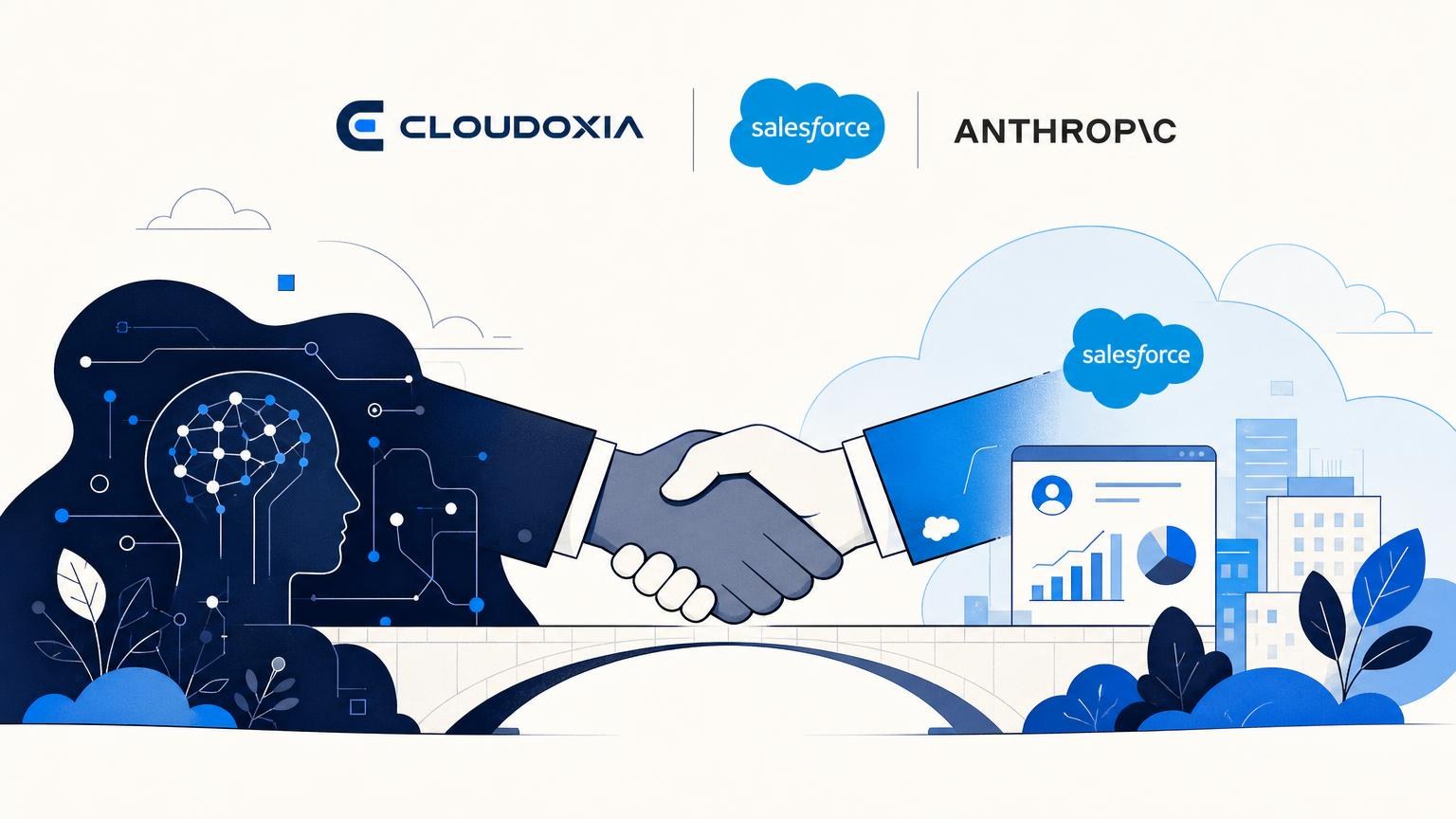
The announcement of Claudeforce caught a lot of people off guard. Not because Salesforce partnering with an AI company was surprising – they’ve been doing that for years – but because of how deep this integration actually goes. This isn’t a chatbot bolted onto a CRM. It’s a fundamental rethinking of how people interact with business software, and it has real implications for any organization running Salesforce.
Here’s what the partnership between Salesforce and Anthropic actually means, what it changes in practice, and what you need to do about it now – not six months from now when everyone else is scrambling.
The Evolution of Claudeforce: Bridging Anthropic and Salesforce
Quick Verdict: The Strategic Impact of the Partnership
If you’re short on time, here’s the essential picture: Claudeforce is a bidirectional integration between Anthropic’s Claude AI and Salesforce’s ecosystem. It works in two directions. Users can access Salesforce data and actions from within Claude (called “Salesforce in Claude”), and Claude’s reasoning capabilities power features inside Salesforce itself (called “Claude in Salesforce”). The initial release focuses on 37 preconfigured sales skills, with an open beta expected from September 2026.
For most Salesforce customers, this won’t require ripping anything out. Agentforce isn’t going away. Your existing Flows, Apex, and automations still matter. But Claudeforce adds a new interaction layer that could dramatically reduce the time your team spends hunting for information across records and objects.
The bottom line: if your Salesforce data is clean and your governance is solid, you’re well-positioned. If it’s not, Claudeforce will expose those weaknesses faster than any audit ever could.
Defining Claudeforce: Beyond a Simple AI Integration
Claudeforce is neither a new Salesforce Cloud product nor a standalone AI model. It’s the branded name for a partnership that connects Claude’s language understanding and reasoning capabilities directly to Salesforce’s data, workflows, permissions, and business logic.
What makes this different from previous AI integrations is the concept of context. Claude doesn’t just pull data from Salesforce like a reporting tool. It understands the relationships between accounts, opportunities, activities, and contacts – then reasons about them in ways that mirror how an experienced sales rep or service agent would think.
A practical example: instead of opening Salesforce, navigating to the Opportunities tab, filtering by close date, cross-referencing activity history, and manually assessing risk, a rep can ask Claude a single question: “Which of my Q4 opportunities are at risk and why?” Claude analyzes the relevant Salesforce context, identifies patterns (like stalled deals with no recent activity), and can even trigger follow-up actions like creating tasks or escalating cases.
This shift – from navigating software to describing outcomes – is what makes Claudeforce significant for enterprise teams.
Technical Synergy: How Claude and Salesforce Interact
Salesforce in Claude: Native CRM Skills and Plugins
The “Salesforce in Claude” component delivers Salesforce capabilities directly into Claude’s interface through a plugin architecture. At launch, 37 preconfigured sales skills cover the most common sales workflows:
- Meeting preparation: Claude pulls together account history, recent communications, open opportunities, and key contacts before a call.
- Pipeline analysis: Instead of building reports manually, reps describe what they want to understand about their pipeline and Claude assembles the analysis.
- Account reviews: Claude synthesizes information across multiple related records to give a holistic account picture.
- Action execution: Claude can update leads, create tasks, escalate cases, and modify records directly in Salesforce based on the conversation.
The pilot launched in mid-2026, with an open beta planned for September 2026. The initial skill set targets sales roles, but Anthropic and Salesforce have confirmed that service, marketing, and other business functions will follow.
Claude in Salesforce: Powering the Atlas Reasoning Engine
The reverse direction is equally important. Claude operates as a reasoning model within Salesforce’s own AI infrastructure, specifically powering components of the Atlas Reasoning Engine, Agentforce Coworker, and Agentforce Vibes.
This means organizations building agents through Agent Builder can tap into Claude’s language understanding without leaving the Salesforce ecosystem. You’re not choosing between Agentforce and Claude – you’re using Claude through Agentforce when it makes sense.
Three technical building blocks make this possible:
- Headless 360 exposes Salesforce data, business logic, permissions, and governance independently of the Lightning Experience UI. Think of it as making your CRM “API-first” for AI consumption.
- Model Context Protocol (MCP) is an open standard that lets AI agents discover and use capabilities across systems. It’s the connective tissue that allows Claude to understand what Salesforce can do.
- AIforce bundles MCP servers, interfaces, and CLI tools into an enterprise package, making business data and workflows available to any agent without custom integration work.
Claude is also being embedded more deeply into Slack, following the same principle: business intelligence and AI should be available wherever your team already works.
Business Outcomes and Operational Efficiency
Transitioning from Manual Search to Natural Language Intent
The most tangible change Claudeforce introduces is a shift in how people use their CRM. Traditional CRM usage follows a predictable pattern: open app, navigate to object, find record, review fields, take action, repeat. It’s functional but slow, and it assumes users know exactly where to look.
With Claudeforce, the interaction model flips. Users describe what they want to accomplish, and the AI handles the navigation, data retrieval, and analysis. Consider a sales manager preparing for a weekly pipeline review. Today, that might involve:
- Running three or four reports in Salesforce
- Cross-referencing activity data in each opportunity
- Checking email threads in Outlook or Gmail
- Manually compiling a summary for the team meeting
With Claudeforce, that same manager could say: “Show me all opportunities closing this quarter where the last customer contact was more than two weeks ago, ranked by deal size.” Claude assembles the answer in seconds, pulling from the same Salesforce data but eliminating 30-45 minutes of manual work.
This isn’t hypothetical efficiency. Organizations that have participated in early pilots report that information-gathering tasks – the kind that eat up the first hour of every morning for most sales teams – shrink dramatically when natural language replaces manual navigation.
Comparison Table: Traditional CRM vs. Claudeforce Workflows
| Dimension | Traditional CRM Workflow | Claudeforce Workflow |
|---|---|---|
| User interaction | Click-based navigation through objects and records | Natural language queries describing desired outcomes |
| Data synthesis | Manual: user cross-references multiple records and reports | Automated: Claude aggregates context across related records |
| Action execution | User performs each step (update field, create task, send email) | Claude can trigger actions directly after analysis |
| Learning curve | High: requires knowledge of Salesforce UI, objects, and report building | Lower: users describe goals in plain language |
| Meeting prep time | 30-60 minutes of manual data gathering | Minutes, with AI-assembled briefings |
| Availability | Requires Salesforce UI access | Available in Claude, Slack, or Salesforce |
| Process control | Fully deterministic, user-driven | AI-assisted with Salesforce permissions enforced |
| Best suited for | Structured, repeatable data entry and process execution | Knowledge-intensive tasks, analysis, and multi-record synthesis |
The key insight from this comparison isn’t that Claudeforce replaces traditional CRM usage. It’s that each approach serves different work patterns. Structured data entry and process execution still benefit from the standard UI. But analysis, preparation, and cross-record reasoning – tasks where people spend the most unproductive time – are where Claudeforce delivers the biggest gains.
Strategic Implementation and Data Governance
The Critical Role of Data Models and Permissions
Here’s what most coverage of the Claudeforce partnership glosses over: AI agents are only as good as the data and governance they operate on. If your Salesforce org has inconsistent data, poorly defined processes, or unclear permission structures, Claudeforce won’t fix those problems. It will amplify them.
An AI agent that can reason across your entire CRM is powerful when your data is clean. It’s dangerous when it’s not. Imagine Claude confidently telling a sales rep that an account has no open support cases – because the service team logs cases in a different system or uses inconsistent naming conventions. That’s not an AI failure. It’s a data architecture failure that AI made visible.
The critical foundations include:
- Data completeness: Fields that are “optional” in your current workflow become essential when an AI agent needs them for reasoning. If activity logging is inconsistent, Claude can’t accurately assess deal health.
- Process clarity: Defined stage criteria, exit requirements, and escalation paths give AI agents the rules they need to make sound recommendations.
- Permission models: Claude respects Salesforce’s existing sharing and permission framework. But if your permissions are overly broad or inconsistently applied, AI-generated insights might expose data to users who shouldn’t see it.
- Governance policies: Who reviews AI-triggered actions? What’s the approval process for automated record updates? These questions need answers before deployment, not after.
Preparing Your Infrastructure for Claudeforce Deployment
Organizations that want to be ready for Claudeforce should focus on foundational work now, even while the product is still in beta. A practical preparation checklist:
- Audit your data model. Identify fields with low fill rates, objects with inconsistent usage, and records that haven’t been updated in months. These are the gaps Claude will stumble on.
- Document your business processes. If your sales stages, service escalation paths, or lead qualification criteria exist only in people’s heads, they need to be formalized. AI can’t follow unwritten rules.
- Review sharing and permissions. Run a permissions audit to ensure that field-level security, record sharing rules, and profile/permission set assignments accurately reflect who should see what.
- Identify high-value use cases. Start with tasks where your team spends the most time compiling information across multiple records or systems. These are your best candidates for early Claudeforce adoption.
- Establish AI governance. Define policies for AI-triggered actions: what requires human approval, what can be automated, and how you’ll monitor AI behavior over time.
This is exactly the kind of work where having a partner with deep Salesforce architecture experience pays off. At Cloudoxia, for instance, our certified architects routinely conduct data model and governance assessments as part of our structured five-phase methodology – the kind of foundational work that determines whether an AI deployment succeeds or creates new problems. As one client put it in a recent review: “They always take the time to understand what we’re trying to solve and achieve, propose clear solution options with tradeoffs, and then execute cleanly and efficiently.”
Coexistence and Future: Agentforce and Enterprise AI
One of the most common questions we hear from Salesforce customers is whether Claudeforce replaces Agentforce. The short answer: no. They serve different purposes and will coexist.
Agentforce is an orchestration layer for defined business processes. You specify which data an agent accesses, which actions it performs, and where a language model makes decisions. It combines AI reasoning with deterministic logic – Flows, Apex, structured process steps. Think of it as building a specific machine for a specific job.
Claudeforce (specifically the “Salesforce in Claude” component) provides a more open-ended, dialogue-based way to interact with Salesforce data. Rather than modeling a specific process, users ask questions and request actions in natural language. It’s exploratory and flexible rather than structured and repeatable.
The overlap exists primarily in knowledge-intensive tasks where a user needs to synthesize information. For structured, recurring, or event-driven processes – like case routing, lead assignment, or approval workflows – Agentforce remains the right tool. Your existing Agentforce investments retain their value.
Think of it this way: Agentforce is your assembly line, built for consistency and control. Claudeforce is your research assistant, built for flexibility and insight. Most organizations will use both.
Common Questions Regarding the Claudeforce Ecosystem
Is Claudeforce a new Salesforce product I need to purchase separately?
Claudeforce isn’t a standalone Cloud or SKU. It’s the branded name for the expanded partnership between Salesforce and Anthropic. Pricing details for the various components (Salesforce in Claude, Claude in Salesforce, AIforce) are still being finalized as the product moves from pilot to open beta. Expect Salesforce to bundle some capabilities into existing licenses while charging separately for others.
What happens to my existing Salesforce automations and customizations?
Nothing changes. Your Flows, Apex triggers, validation rules, and custom objects continue to function exactly as they do today. Claudeforce adds a new interaction layer on top of your existing architecture – it doesn’t replace it. In fact, well-built automations and clean data models make Claudeforce more effective.
Can Claude access data from systems outside Salesforce?
Through the Model Context Protocol (MCP), Claude can potentially connect to other systems that support the standard. However, the initial Claudeforce release focuses specifically on Salesforce data and actions. Cross-system capabilities will likely expand as MCP adoption grows across enterprise software vendors.
How does Claudeforce handle data security and compliance?
Claude operates within Salesforce’s existing security framework. It respects field-level security, sharing rules, and permission sets. If a user doesn’t have access to a record in Salesforce, Claude won’t surface that data to them. Organizations should still review their permission models before deployment to ensure they accurately reflect intended access levels.
Is Claudeforce available for all Salesforce editions?
Salesforce hasn’t published final edition requirements. Based on the reliance on features like Headless 360 and Agent Builder, Enterprise Edition or above is a reasonable expectation. Check Salesforce’s official release notes as the open beta launches in September 2026 for confirmed compatibility.
When should I start preparing for Claudeforce?
Now. Even though the product is in pilot, the preparation work – data cleanup, process documentation, permissions auditing, governance policies – is valuable regardless of whether you adopt Claudeforce immediately. These foundations improve your entire Salesforce experience, not just AI features. Organizations that treat this as a six-month project starting at general availability will be behind those who start foundational work today.
The Future of Autonomous Enterprise Software
Claudeforce represents something bigger than a single product announcement. It signals a shift in how enterprise software works: from applications you operate to platforms that operate on your behalf, guided by your intent.
The trajectory is clear. First came AI that generated text and answered questions. Then came AI that could reason about business context. Now we’re entering the phase where AI identifies relevant data, analyzes it, and takes action – all within the guardrails of enterprise permissions and governance. The partnership between Salesforce and Anthropic is one of the most concrete examples of this evolution.
For Salesforce customers, the practical takeaway is straightforward: the quality of your Salesforce foundation has never mattered more. Clean data, defined processes, and proper governance aren’t just best practices anymore. They’re prerequisites for the next generation of enterprise AI.
If your organization needs help getting that foundation in shape – whether it’s a data model overhaul, a permissions audit, or ongoing managed services to keep everything running smoothly – working with a team that understands both the technical architecture and the business context makes a real difference. Cloudoxia’s managed services team provides exactly that kind of support, with a median first response time under four hours and full code ownership handed back to you. Maximize Your Salesforce ROI by ensuring your CRM is ready for what comes next.