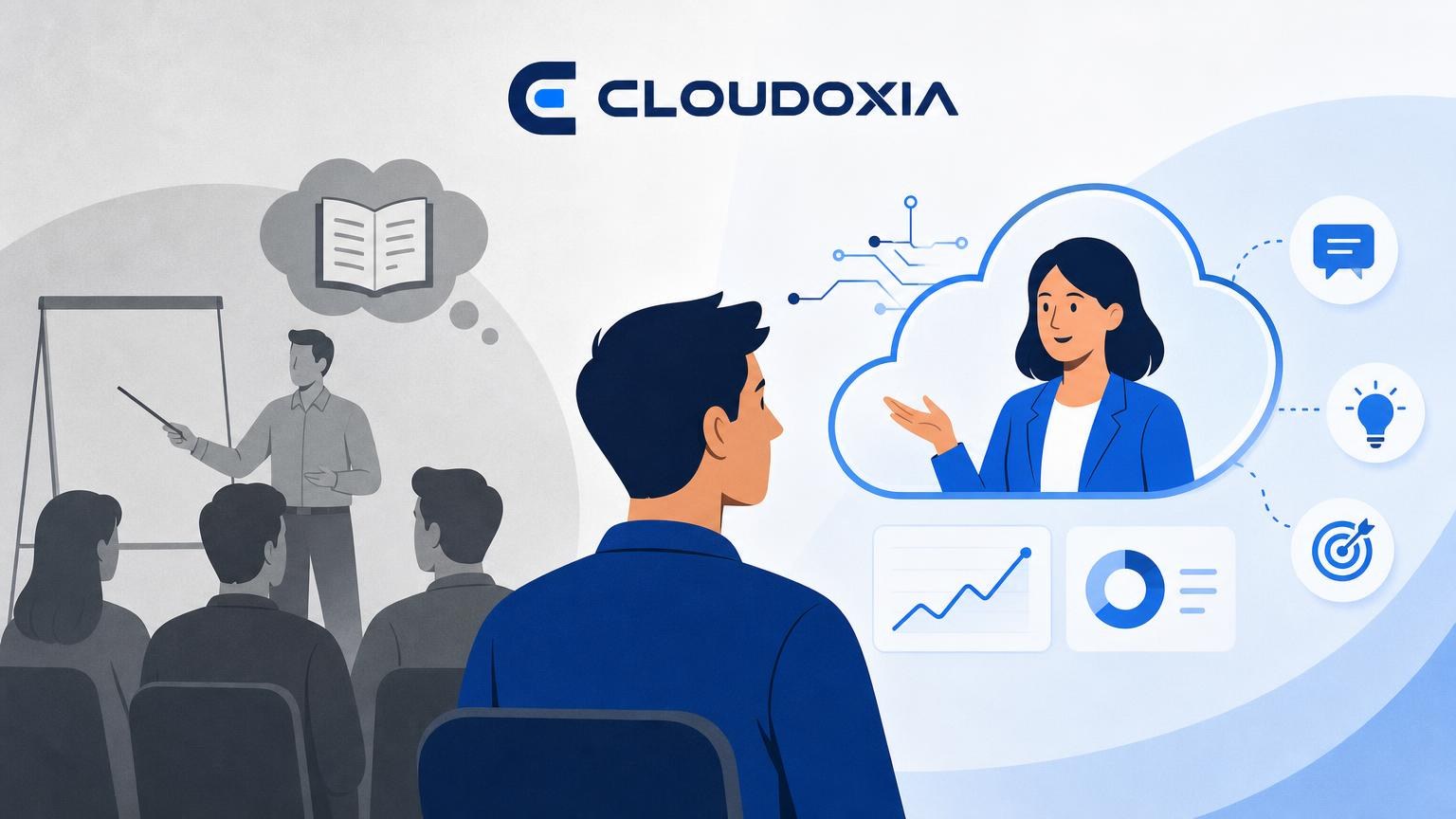
Most sales reps have sat through the same training: a two-day workshop in a conference room, a binder full of objection-handling scripts, and a motivational closer who hasn’t carried a quota since 2015. Then Monday hits, and they’re back on calls with none of that theory within arm’s reach. The gap between how reps learn and how they actually sell has been a persistent problem, and it’s one that generic training programs have never solved well. The arrival of Salesforce’s Agentforce Sales Coach changes the equation for reps in a fundamental way: instead of learning in a vacuum and hoping the knowledge sticks, reps get AI-driven coaching embedded directly in their daily workflow. This isn’t a marginal improvement over traditional methods. It’s a structural shift in how sales organizations build skills, correct mistakes, and scale performance across teams. For companies already running Salesforce, the question isn’t whether AI coaching will replace old-school training entirely, but how quickly it will make the old model feel obsolete. Here’s what actually changes for reps on the ground.
Shifting from Theoretical Learning to Real-Time Execution
The core tension in sales training has always been timing. Reps learn techniques weeks or months before they need them, then face real buyer objections with only a hazy memory of what they practiced. This disconnect isn’t a failure of effort; it’s a failure of design. The traditional model treats learning as an event. Agentforce treats it as a continuous process woven into actual selling.
The Limitations of Static Classroom Training
Classroom-style sales training, whether in-person or through an LMS, operates on a batch model. You pull reps off the floor for a day or a week, cover a curriculum designed for the average performer, and send everyone back with the same playbook. The problems with this approach are well-documented.
Retention drops fast. Research on the Ebbinghaus forgetting curve shows that people lose roughly 70% of new information within 24 hours unless they actively reinforce it. A rep who learns a new discovery framework on Tuesday has likely forgotten the key steps by Friday’s pipeline call.
Context is missing. Generic training teaches techniques in isolation: “Here’s how to handle a pricing objection.” But real deals are messy. The pricing objection on a $40K mid-market deal with a CFO gatekeeper looks nothing like the same objection on a $500K enterprise deal with a procurement committee. Static training can’t account for those differences.
Feedback is delayed. Even if a manager observes a rep’s calls, the coaching conversation usually happens days later during a scheduled one-on-one. By then, the rep has already moved on to new deals and the teachable moment has passed.
How Agentforce Sales Coach Embeds Learning in the Workflow
Agentforce Sales Coach flips the model by meeting reps where they already work: inside Salesforce. Instead of pulling reps out of their CRM to learn, the AI coach operates within the flow of deal management, surfacing guidance and practice opportunities tied to real pipeline activity.
A rep preparing for a renewal call with a customer who’s shown declining engagement scores doesn’t need to search a knowledge base for renewal best practices. The Sales Coach can prompt a role-play scenario based on that specific account’s data, including the customer’s usage patterns, contract history, and any open support tickets.
This matters because it collapses the gap between learning and doing. The rep isn’t memorizing abstract frameworks; they’re rehearsing a conversation they’ll have in two hours, using data from the actual deal. The coaching is specific, timely, and immediately applicable.
For organizations running complex Salesforce ecosystems, getting Agentforce configured properly means connecting it to the right data sources and workflows. This is where implementation quality makes a real difference: a well-architected deployment ensures the Sales Coach pulls from accurate, up-to-date CRM data rather than stale or incomplete records. Cloudoxia’s Agentforce implementation work focuses on exactly this, connecting AI agents to existing Salesforce data and workflows so the coaching output is actually trustworthy.
Personalization at Scale: Beyond the ‘One-Size-Fits-All’ Curriculum
Generic training treats every rep the same. A ten-year veteran who struggles with executive presence gets the same curriculum as a new hire who can’t qualify leads. This wastes everyone’s time and fails to move the needle where it matters most.
Tailoring Feedback to Individual Rep Performance Data
Agentforce Sales Coach analyzes each rep’s actual performance data to identify specific skill gaps. It doesn’t guess at what a rep needs; it looks at their win rates by deal type, their conversion rates at each pipeline stage, their average deal cycle length compared to peers, and where deals tend to stall or die.
If a rep consistently loses deals during the negotiation phase but excels at discovery, the AI coach focuses its attention on negotiation skills rather than wasting time reinforcing what the rep already does well. This kind of individualized attention used to require a dedicated sales coach for every five or six reps, a ratio most organizations can’t afford. AI makes that level of personalization available to every rep on the team simultaneously.
The feedback itself is grounded in data rather than opinion. Instead of a manager saying “I think you need to work on your closing,” the AI can point to specific patterns: “Your deals over $100K have a 15% lower close rate than the team average, and they tend to stall after the proposal stage. Here’s a practice scenario focused on building urgency with senior stakeholders.”
Contextual Role-Play Based on Live CRM Opportunities
This is where things get genuinely interesting. Traditional role-play uses fictional scenarios: “Pretend you’re selling to a healthcare company with budget concerns.” Agentforce Sales Coach can generate role-play exercises based on the rep’s actual open opportunities.
A rep with a stalled deal at a manufacturing company can practice the next conversation using real context: the stakeholders involved, the competitive alternatives the buyer is considering, and the specific objections that have come up in previous interactions. The AI plays the buyer, responding with realistic pushback based on the deal’s characteristics.
This turns practice from a theoretical exercise into a rehearsal. Actors don’t practice Shakespeare by reading random sonnets; they rehearse the specific scenes they’ll perform. Sales reps should work the same way, and Agentforce makes that possible without requiring a manager to block out time for every practice session.
The quality of these role-plays depends heavily on the quality of CRM data feeding them. If your Salesforce instance is full of incomplete records and outdated opportunity stages, the coaching output will reflect that garbage-in, garbage-out reality. Getting your data house in order is a prerequisite, not an afterthought.
The Feedback Loop: Instant Coaching vs. Monthly Reviews
Speed of feedback is one of the biggest differentiators between AI-powered coaching and traditional sales management. The difference isn’t incremental; it fundamentally changes how quickly reps can correct course and build new habits.
Eliminating the ‘Forgetting Curve’ with Just-in-Time Guidance
The forgetting curve is brutal, but it has a well-known antidote: spaced repetition and timely reinforcement. Agentforce Sales Coach delivers both automatically.
When a rep logs notes from a discovery call, the AI can immediately analyze whether the rep captured the right information: budget, authority, need, timeline, or whatever qualification framework the organization uses. If key elements are missing, the coach flags it right away, not three weeks later during a pipeline review.
This just-in-time approach means reps correct mistakes while the conversation is still fresh. They can follow up with the prospect to fill gaps the same day instead of realizing weeks later that they never confirmed the decision-making process. Over time, this rapid feedback loop builds habits much faster than periodic training sessions.
Think about it like learning a language. You’d improve faster with a tutor who corrects your grammar in real-time during conversation than with a teacher who grades your essays a month after you write them. Sales skill development works the same way.
Objective AI Analysis vs. Subjective Manager Observations
Every sales manager has biases. Some overvalue confidence and mistake a smooth talker for a strong seller. Others focus heavily on activity metrics and miss that a rep with fewer calls is actually having better conversations. These biases aren’t malicious; they’re human. But they do create inconsistency in coaching quality across a team.
Agentforce Sales Coach provides a consistent analytical baseline. It evaluates rep performance against the same criteria every time, using data rather than gut feel. This doesn’t replace human judgment entirely, and it shouldn’t. A good manager brings emotional intelligence and relationship context that AI can’t replicate. But the AI layer ensures that no rep falls through the cracks simply because their manager is stretched thin or has blind spots.
The combination works best when managers use AI-generated insights as a starting point for their own coaching conversations. Instead of spending 30 minutes of a one-on-one reviewing call recordings, the manager can walk in already knowing which specific skills need attention and spend that time on higher-value mentoring.
Impact on Sales Productivity and Skill Acquisition
The practical question every sales leader asks: does this actually move numbers? Early data from organizations deploying Agentforce for sales coaching suggests meaningful improvements in two critical areas: ramp time for new hires and consistency across distributed teams.
Reducing Time-to-Ramp for New Hires
New hire ramp time is one of the most expensive hidden costs in sales. The industry average sits around six to nine months before a new rep hits full productivity, and during that period, the company is paying a full salary plus benefits for someone who’s barely contributing to revenue.
Agentforce Sales Coach accelerates ramp by giving new hires a personal coach from day one. Instead of shadowing a senior rep for weeks (who may or may not be a good teacher), new hires can practice scenarios tailored to their specific territory, product line, and target buyer persona. They get immediate feedback on every practice session, and the difficulty scales as their skills improve.
One pattern we’ve seen work well is pairing Agentforce coaching with a structured onboarding program. The formal program covers product knowledge, company values, and process. The AI coach handles the skill-building side: objection handling, discovery technique, presentation skills. This division of labor lets each channel do what it does best.
Organizations that have worked with Cloudoxia on Agentforce deployments have found that getting the initial configuration right, particularly the mapping of coaching scenarios to actual sales stages and buyer personas, dramatically affects how useful the tool is during onboarding. As one Salesforce AppExchange reviewer noted about working with the Cloudoxia team: “They always take the time to understand what we’re trying to solve and achieve, propose clear solution options with tradeoffs, and then execute cleanly and efficiently.” That kind of thoughtful setup work is what separates a coaching tool that reps actually use from one that collects dust.
Scaling Mastery Across Distributed Teams
Remote and hybrid sales teams create a coaching distribution problem. Reps in satellite offices or working from home get less face time with managers, fewer opportunities for informal mentoring, and less exposure to how top performers operate. The result is often a widening performance gap between reps who sit near leadership and those who don’t.
AI coaching eliminates geography as a factor in skill development. A rep in Austin gets the same quality coaching as a rep sitting ten feet from the VP of Sales in the headquarters office. The AI doesn’t have favorites, doesn’t get distracted by other priorities, and is available at 6 AM or 11 PM.
This is particularly valuable for companies scaling into new markets or adding teams in different time zones. The coaching infrastructure scales instantly without needing to hire additional managers or trainers. A team of 20 reps gets the same per-person coaching attention as a team of 200.
The consistency angle matters too. When every rep is coached against the same standards and frameworks, the entire organization develops a shared selling language. Pipeline reviews become more productive because everyone defines stages the same way. Forecasting improves because qualification criteria are applied uniformly. These second-order effects are easy to overlook but significant over time.
Evolving the Sales Culture from Supervision to Enablement
The most profound change Agentforce Sales Coach brings isn’t technological; it’s cultural. Traditional sales management often defaults to supervision: tracking activity metrics, monitoring call recordings, and flagging underperformance. This creates a dynamic where coaching feels like surveillance, and reps become defensive rather than open to growth.
When AI handles the routine coaching and skill assessment, managers are freed to focus on what humans do best: building trust, providing career guidance, helping reps think strategically about their territory, and removing organizational obstacles. The manager’s role shifts from inspector to enabler.
Reps notice this shift. When coaching comes from an AI tool, there’s less ego involved. A rep who bristles at a manager’s critique of their discovery technique may be perfectly willing to accept the same feedback from an AI coach, practice the skill, and improve. The emotional dynamics are different, and that difference matters for adoption.
This doesn’t mean managers become irrelevant. Quite the opposite. Freed from the grind of basic skill coaching, good managers can invest their time in the high-judgment activities that actually require human insight: navigating complex deal politics, coaching through career transitions, and building team culture. The AI handles the repetitive coaching; the human handles the nuanced mentoring.
For sales organizations considering this shift, the implementation approach matters enormously. Deploying Agentforce as a surveillance tool rather than an enablement tool will backfire. Reps need to see the AI coach as a resource that helps them earn more money, not a system that reports their weaknesses to management. How you position and configure the tool determines whether your team embraces it or resists it.
The comparison between Agentforce Sales Coach and generic sales training ultimately comes down to this: one approach treats learning as something that happens outside of work, while the other treats it as something inseparable from work itself. For reps, that distinction changes everything about how quickly they improve, how consistently they perform, and how confident they feel walking into their next conversation.
If your organization is running Salesforce and looking to get more from both your CRM investment and your sales team’s potential, Cloudoxia can help you design and deploy Agentforce solutions that actually fit your selling motion. Maximize Your Salesforce ROI with expert consulting and predictable monthly support, so your reps spend less time guessing and more time closing.